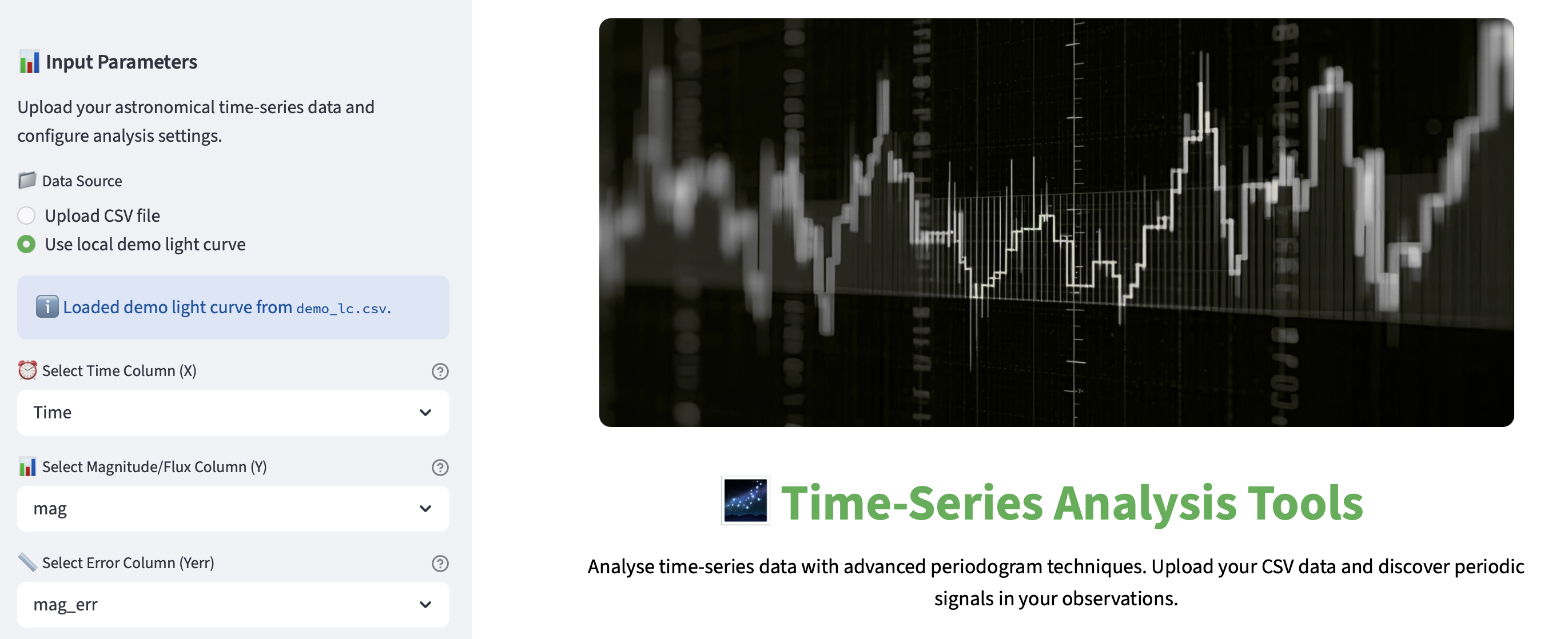
Hamburg Observatory Colloquium 2025
Invited talk: Unsupervised machine learning for variability analysis in time-domain astronomy
Astronomer • Data scientist
Hey! my name is Princy and I'm originally from Madagascar.
I am an astronomer and data scientist with a PhD in Astronomy & Astrophysics (Radboud University & KU Leuven), specialising in time-series analysis, unsupervised machine learning, and statistical validation of large, heterogeneous datasets.
Please feel free to get in touch if you would like to collaborate.
Loading publications from ORCID…
Hamburg Observatory Colloquium 2025
Invited talk: Unsupervised machine learning for variability analysis in time-domain astronomy
12th International Meeting on Hot Subdwarfs & Related Objects — North Carolina, USA 2025
Talk: Unravelling Hot Subdwarfs and Binaries Variability with Gaia DR3 and Machine Learning
KOPAL 2024 Conference (Flash Talk) — Litomyšl, Czech Republic 2024
MW-Gaia WG2 Conference — Sofia, Bulgaria 2023
Talk: Classification of variable stars observed in multiple filters with MeerLICHT and BlackGEM
TASC/KASC 15 Conference — Porto, Portugal 2024
AM CVn 5 Workshop — Armagh, UK 2023
sdOB11 Conference — Armagh, UK 2023
TASC/KASC 13 Conference — Leuven, Belgium 2022
sdOB10 Conference — Liège, Belgium 2022
Oxford Machine Learning School (OxML) — Oxford, UK
Attendee 2023 & 2025
Loading GitHub repositories…
My research focuses on advancing our understanding of the formation and evolution of hot sub-luminous stars — compact, evolved stellar objects — by studying their photometric variability using multi-band time-series data and modern machine learning techniques.
Time-domain astronomy poses significant observational challenges: data are often sparse, irregularly sampled, and affected by gaps due to weather, telescope availability, and the day–night cycle. These limitations lead to large uncertainties in fundamental parameters such as periods and amplitudes, motivating the development of robust statistical and computational tools.
To this end, my PhD introduces statistical and machine learning methods that efficiently handle unevenly sampled light curves of an impressively large number of stars. Simultaneously, it contributes to the understanding of the formation and evolution of compact evolved stars, which display photometric variability.
I developed hybrid frequency-search methods (the Ψ-statistic) that combine the Lomb–Scargle periodogram with the Lafler–Kinman statistic to improve periodicity detection in sparsely and irregularly sampled light curves.
These tools were successfully applied to MeerLICHT, BlackGEM, and Gaia datasets, demonstrating improved robustness and reduced aliasing compared to classical approaches.
I designed an unsupervised machine learning framework using t-SNE and UMAP applied to Gaia DR3 multi-epoch photometry. Using statistical features extracted from light curves, this approach enables the discovery and separation of variable stellar populations without relying on labelled training data.
The method successfully disentangled variable hot subdwarfs from cataclysmic variables — two classes notoriously difficult to separate photometrically — highlighting the power of unsupervised learning in large astronomical surveys.
I extended the unsupervised framework to significantly larger datasets (≈13,500 objects), spanning diverse stellar populations between the main sequence and white dwarf sequence in the colour–magnitude diagram.
The resulting embeddings revealed distinct clusters corresponding to different stellar variability classes, demonstrating strong scalability and applicability to upcoming large-scale time-domain surveys.
In a recent project, I investigated BlackGEM’s capability to detect multi-periodic pulsations using simultaneous three-band photometry (u, q, i).
I developed a proof-of-concept method for pulsation mode identification based on amplitude ratios, demonstrated using the benchmark hot pre-white dwarf PG1159–035, with promising agreement with modes known from the literature.
Together, these projects highlight my dual expertise in statistical time-series analysis and machine learning applied to large, heterogeneous astronomical datasets.

IBM SkillsBuild

DeepLearning.AI

Coursera • IBM
Coursera • IBM
Coursera • IBM
Coursera • IBM